Guangshan Expressway's Fogang and Zhongluotan Toll Stations (Guangzhou-bound) Go Live Today, Adding New Options for Smart Travel
Guangdong‘s Guang-Shao Expressway completed smart upgrades at Fogang and Zhongluotan toll stations. AI license plate recognition, self-service card machines, and ETC exception handling terminals reduce lane passage time by 10 seconds. Zhongluotan‘s ‘smart cloud cockpit‘ enables one operator to remotely manage three stations, resolving 60% of exceptions within 19 seconds on average.
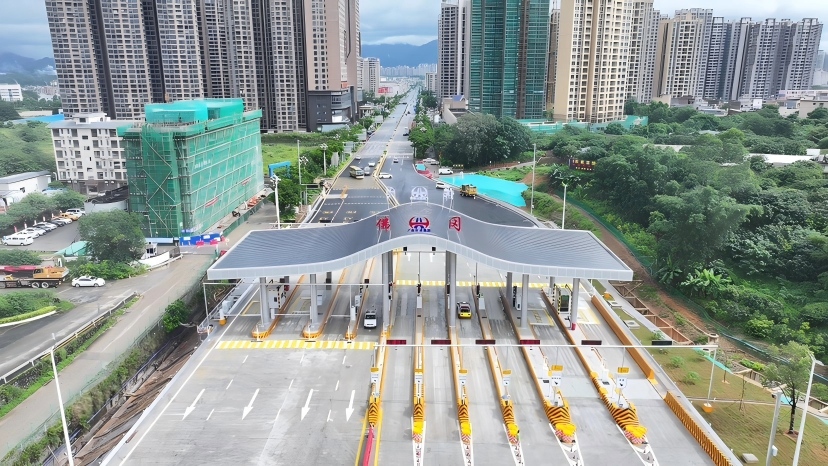
Automatic vehicle identification, self-service card dispensing and collection, QR code payment—all in one seamless flow. On July 15, the Fogang and Zhongluotan toll stations (Guangzhou direction) on the Guangshan Expressway, operated by Guangdong Transportation Group, completed their smart upgrade and officially opened for operation, offering drivers and passengers a "silky smooth" travel experience for the summer holiday season.
Fogang Station: Smart Empowerment Draws Praise for "Stop-and-Go" Efficiency
Located in Fogang County, Qingyuan City, Fogang Station serves as a vital hub connecting the county seat and National Highway G106. To further enhance travel efficiency and alleviate peak-hour congestion, the station underwent a full closure for construction starting March 5, 2026.
Following the renovation, the station's lane configuration has been expanded from the original 3-in and 4-out to 4-in and 6-out. The entrance features 2 ETC lanes and 2 ETC hybrid lanes (with toll booths on the outermost side); the exit features 4 ETC lanes and 2 ETC hybrid lanes (with toll booths on the outermost side).
The upgrade equips Fogang Station with smart devices including AI-based vehicle plate and model recognition, self-service card dispensing and collection machines, and ETC special‑case handling terminals. When a vehicle enters a lane, the AI recognition device quickly identifies the license plate and determines the vehicle type, significantly reducing recognition time. For vehicles without ETC, the self-service card machines enable drivers to collect and return toll cards and complete payments independently. In cases of abnormal deductions or plate mismatches, drivers can use the ETC special‑case terminals at the exit to resolve issues without waiting for manual intervention, greatly cutting down waiting time.
"Getting on and off the expressway at Fogang is now very convenient and smooth. The new card machines save a lot of time, and if you have ETC installed, it's even faster—basically stop-and-go. The experience is excellent," said driver Master Li, praising the upgraded station.
Zhongluotan Station: Two‑Way Full Connectivity Boosts Efficiency
Zhongluotan Station is located in Zhongluotan Town, Baiyun District, Guangzhou, serving as a key transportation node connecting to National Highway G105. The station handles dense traffic with a high proportion of trucks. During peak hours, manual toll lanes are time‑consuming and put significant pressure on the system.
The newly opened Guangzhou‑direction facility comprises 8 lanes (3 in and 5 out), with entrances and exits similarly equipped with AI vehicle recognition, self‑service card machines, and ETC special‑case terminals, supporting multiple payment methods including WeChat Pay, Alipay, and digital currency. It is worth noting that the Hunan‑direction side of this station had already opened on October 10, 2025; with the reopening of the Guangzhou direction, the station now achieves full two‑way connectivity.
Notably, Zhongluotan Station is also equipped with a "Smart Cloud Cabin" that enables networked coordination, creating an intensive operation system that allows "one screen to monitor multiple stations, one person to manage multiple posts." Through remote duty systems linked with lane terminals, the cabin enables real‑time control over three surrounding stations. If drivers encounter issues, they can press the help button on the ETC special‑case terminal beside the lane to summon remote assistance from cloud cabin staff. Statistics show that 60% of special cases that previously required on‑site manual handling can now be resolved through the cloud cabin with an average response time of 19 seconds, nearly doubling efficiency.
At the same time, both Fogang and Zhongluotan stations have implemented multiple smart upgrades. ETC lanes are equipped with front and rear dual antennas, working in synergy to double‑check vehicle information, greatly improving accuracy. Running lights have been installed on both sides of the lanes to provide visual guidance for drivers—green lights indicate successful recognition and fast passage. Narrow‑island layouts have been adopted, with 5 toll islands at Fogang and 3 at Zhongluotan narrowed from 2.2 metres to 1 metre, creating a more open layout and more comfortable driving space.
"This upgrade faced multiple challenges: a tight schedule, rainy and hot weather, cross‑discipline construction involving civil engineering, electromechanical systems, and traffic safety facilities, and complex commissioning of smart equipment. To address this, we coordinated construction forces, optimised work sequences, and seized favourable weather for staggered operations, completing the upgrades for both stations in just four months," said Deng Zhigang, Deputy Director of the Guangshan Expressway Reconstruction and Expansion Project (South Section) Management Office. He added that the opening of the two stations will effectively enhance road capacity, improve travel conditions for the public, and facilitate logistics circulation and integrated urban‑rural development along the route.
As a key component of the "One Axis, Two Networks" demonstration project for digital transformation of highway and waterway transport infrastructure in Guangdong Province, the project will continue to push forward the smart upgrades of Tangtang and Beixing stations, and build new stations at Minle and Liangtian, further weaving a dense smart transport network along the route.
The Guangshan Expressway Reconstruction and Expansion Project (South Section) spans 72.6 kilometres, expanding from six to ten lanes (with a left hard shoulder), and is scheduled for completion by 2027. Once finished, the project will further alleviate traffic pressure on the Beijing‑Hong Kong‑Macao Expressway, significantly enhancing infrastructure connectivity between northern Guangdong and the Guangdong‑Hong Kong‑Macao Greater Bay Area, and supporting the implementation of the "Hundreds, Thousands, and Ten Thousands" Project.
Text: Guangzhou Daily New Flower City journalist Li Yan, correspondents Shu Shuman, Peng Yong
Photos: Guangzhou Daily New Flower City journalist Li Yan, correspondents Ping Yizhao, Shu Shuman, Peng Yong, Li Jie
Video: Guangzhou Daily New Flower City journalist Li Yan, correspondents Shu Shuman, Peng Yong, Zou Fang
Guangzhou Daily New Flower City editor: Ma Junxian
Source: https://news.qq.com/rain/a/20260715A0ANTV00