SUMW 2026 Opens With Rail and AV Announcements
The inaugural Singapore Urban Mobility Week (SUMW 2026) opened Wednesday at the Suntec Singapore Convention & Exhibition Centre. Delivering the opening address, Singapore‘s Minister for Transport and Second Minister for Finance, Jeffrey Siow, outlined key developments in rail expansion, autonomous vehicle (AV) deployment, and intelligent transport management.
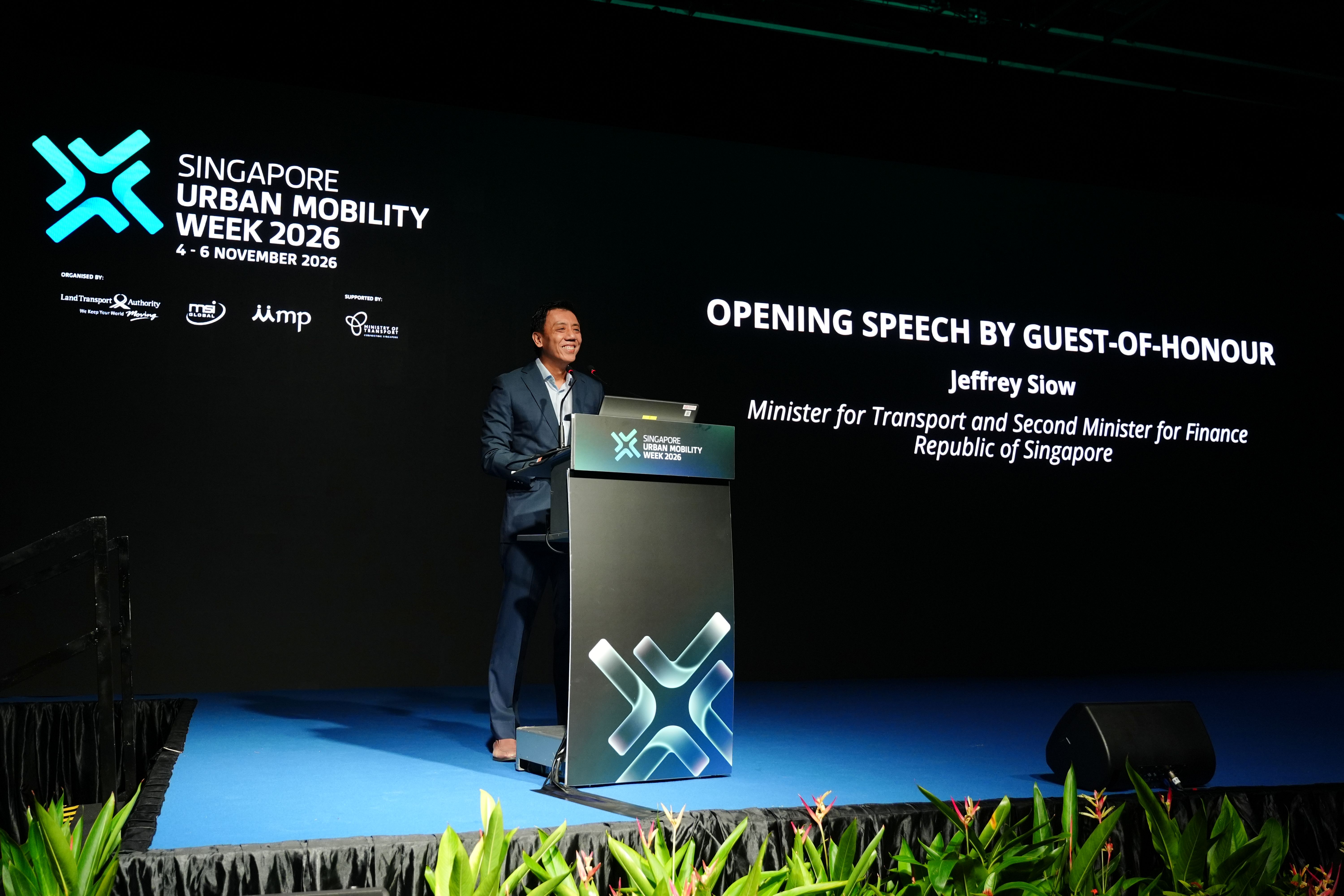
SINGAPORE, November 4, 2026 — The inaugural Singapore Urban Mobility Week (SUMW 2026) opened Wednesday at the Suntec Singapore Convention & Exhibition Centre. Delivering the opening address, Singapore's Minister for Transport and Second Minister for Finance, Jeffrey Siow, outlined key developments in rail expansion, autonomous vehicle (AV) deployment, and intelligent transport management.
Jointly organized by the Land Transport Authority (LTA), MSI Global, and MP Singapore, with support from the Ministry of Transport, the event runs from November 4 to 6 under the theme "Drive the Future – Autonomous Innovation, Smart Infrastructure, and Urban Mobility."
Three MRT Stations to Open in December
Siow announced that three new MRT stations will begin passenger service on December 26, 2026: Bedok South on the Thomson-East Coast Line, Xilin on the Downtown Line, and Sungei Bedok, an interchange connecting the two lines.
The new stations will improve rail connectivity in eastern Singapore, offering commuters additional routes and shorter journeys.
Looking ahead, the first stage of the Jurong Region Line is scheduled to open in mid-2028, while the Cross Island Line will be developed in phases through the 2030s. Singapore is also studying longer-term rail expansion, including the proposed Seletar and Tengah Lines.
Siow emphasized that sustained infrastructure investment, alongside predictive maintenance and automation, remains central to improving the capacity and reliability of Singapore's rail network.
Singapore to Introduce Quarterly AV Reports
Autonomous mobility was another focus of the address. Siow highlighted Singapore's progress in deploying autonomous passenger vehicles and testing commercial AVs on public roads.
He noted that autonomous vehicles could complement conventional public transport, particularly in areas with limited connectivity and during late-night hours.
Beginning in December 2026, Singapore plans to publish quarterly reports on AV deployments, covering operating scale, passenger experiences, and safety outcomes.
The initiative aims to strengthen public confidence through greater transparency and evidence-based assessments of AV performance.
Singapore is also working with transport operators and labor unions to help drivers develop new skills and prepare for emerging roles in the industry.
Advancing Intelligent Transport Management
Beyond autonomous mobility, Siow highlighted Singapore's long-standing use of technology and pricing policies to manage congestion.
The country will transition to its satellite-based Electronic Road Pricing system (ERP 2) on January 1, 2027, replacing the need for conventional physical charging gantries.
Singapore has also introduced free morning off-peak rail travel on designated sections of the North East Line and the Sengkang-Punggol LRT network to encourage commuters to shift their travel times and reduce peak-hour congestion.
Siow stressed that addressing future mobility challenges requires more than expanding infrastructure. Long-term planning, technological innovation, and effective demand management are equally important.
SUMW 2026 brings together policymakers, transport operators, and technology providers to exchange experiences and explore solutions for more efficient, sustainable, and connected urban mobility.